Frequently asked questions
Q1. What is the difference between digital storage and legal archiving?
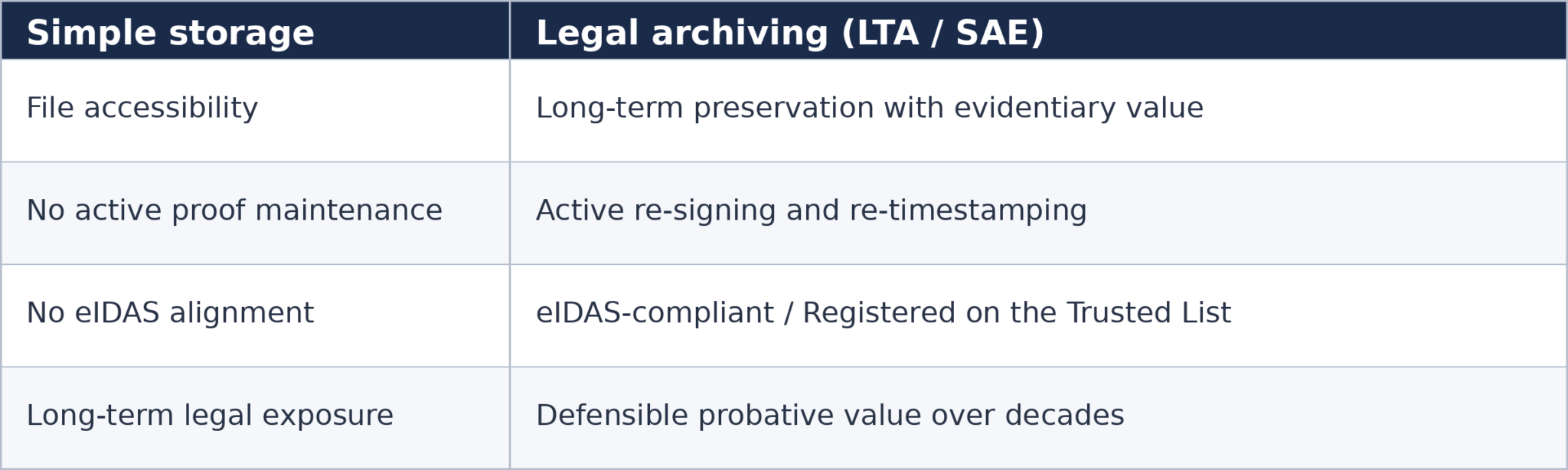
If you can access a file, you’re storing it. If you can prove it in court in 20 years, you’re archiving it. Digital storage keeps files accessible, but it does not maintain their legal standing. As cryptographic certificates expire and technologies evolve, a stored document gradually loses its evidentiary value. Legal archiving actively maintains that value: through re-signing, re-timestamping, and integrity checks, a document signed today remains fully admissible in 10, 20, or 30 years. The question to ask yourself is not “where are my documents?” but “can I still prove them?”
Q2. What is the difference between “preservation” and “legal archiving”?
These two terms are often used interchangeably but they describe different needs. Preservation focuses specifically on maintaining the long-term validity of an electronic signature — ensuring the certificates, timestamps, and cryptographic proof chain remain verifiable decades after signing. Legal archiving covers the broader structured storage of any business document (signed or not) with retention policies, metadata, and compliance with applicable regulations. For electronically signed documents, both layers work together: the signature is preserved, and the document is archived.
Q3. What is a SAE (Système d’Archivage Électronique) and how does your Archive comply?
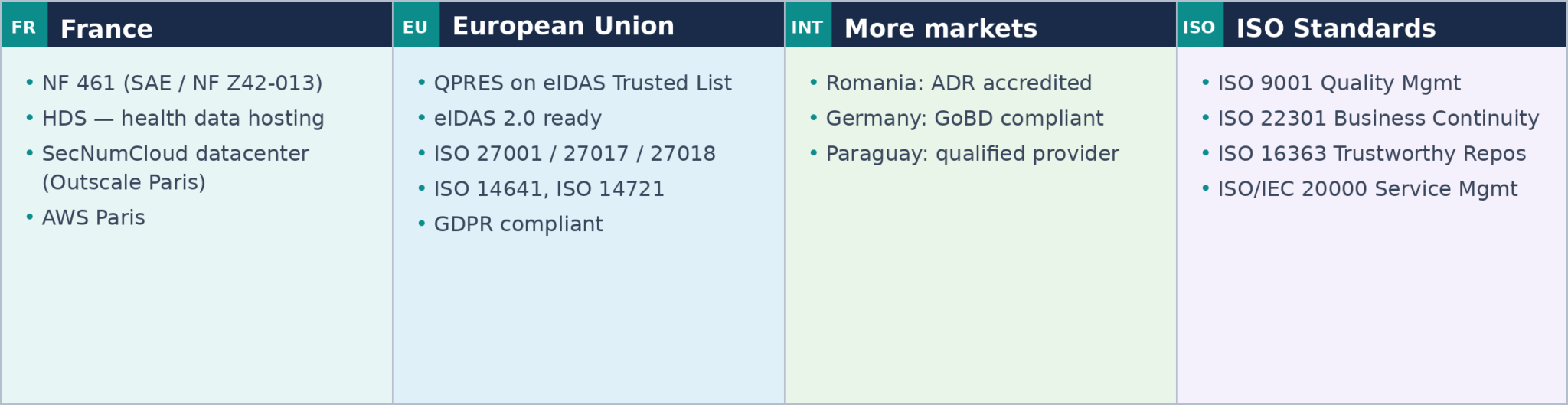
A SAE is a complete electronic archiving system that manages document lifecycle, retention policies, and legal compliance, as defined by the NF Z42-013 standard in France. Our Archive is certified NF 461 (based on NF Z42-013), meaning it operates at the highest level of digital preservation: integrating technology, governance, and regulatory compliance in one coherent system.
Q4. What is QPRES and why does it matter for electronically signed documents?
QPRES (Qualified Preservation Service for Qualified Electronic Signatures and Seals) is a trust service qualified under the eIDAS Regulation and registered on the EU Trusted List. It actively preserves the validity of electronic signatures and seals at the moment of archiving, including verification of certificates, timestamps, and the full chain of proof. Without QPRES, a qualified signature may lose its verifiable value as certificates expire over time.
Q5. How long can documents be archived?
Our Archive supports archiving for periods of up to and beyond 50 years, fully aligned with legal and regulatory retention requirements. Archived documents are stored with integrity checks, encrypted, and replicated across geographically distributed datacenters to prevent data loss.
Q6. Is long-term legal archiving required for electronically signed documents?
In many regulated sectors and jurisdictions, it is either mandatory or strongly advisable. Documents such as employment contracts, financial agreements, insurance policies, and public records must remain legally admissible for their full retention period. A signed document stored without qualified preservation gradually loses its evidentiary standing as cryptographic certificates expire.
Q7. How does eIDAS 2.0 change archiving requirements?
eIDAS 2.0 formally introduces Qualified Electronic Archiving as a trust service at EU level, meaning archiving solutions can now be qualified under the same regulatory framework as e-signatures and timestamps. This elevates the standard for long-term preservation across Europe. Our Archive, as part of Signaturit Group, is actively pursuing this qualification to ensure clients are fully compliant with the evolving European digital trust framework.