









Artificial Intelligence has rapidly moved from an experimental technology to an everyday companion. We use it to write documents, review code, analyze information, and automate routine tasks. For years, this interaction followed a simple logic: humans prompted, machines responded. AI was powerful, but fundamentally passive.
That model is now being replaced.
We are entering the era of AI Agents: systems that do not wait for explicit instructions, but can act autonomously on our behalf. These agents can observe a context, reason about objectives, and execute actions across digital systems—accessing mailboxes, reorganizing agendas, triggering workflows, or interacting with third parties. This shift marks the beginning of the Agentic Economy, where a growing share of digital transactions is initiated and executed by software rather than directly by humans.
The potential impact is profound. Productivity can scale beyond human limits, administrative friction can collapse, and entire business processes can be orchestrated at machine speed. But this transformation introduces a fundamental challenge:
How can we trust an AI agent?
In the physical world, trust is built on identity, delegation, and accountability. Legal entities grant authority to people through formal mandates—such as powers of attorney—defining what they are allowed to do and within which limits. Responsibility is clear, and actions are attributable.
In the agentic economy, this clarity risks disappearing. If an AI agent interacts with a bank, a public administration, or another company:
• How can the counterparty verify who the agent represents?
• How can it be sure the agent was legitimately delegated?
• How can it verify that the agent is acting within its authorized scope?
Without a robust trust layer, autonomous agents become a liability rather than an enabler. This is the core “rogue agent” problem: software that can act, but cannot be reliably trusted. If unresolved, it will prevent the agentic economy from scaling.
Digital Identity as the Missing Trust Layer
The solution does not require inventing trust from scratch. The technologies already used to secure digital transactions for people and businesses can be extended to AI agents, and this is why we saw the AI Agents really close to the future Business Wallet.
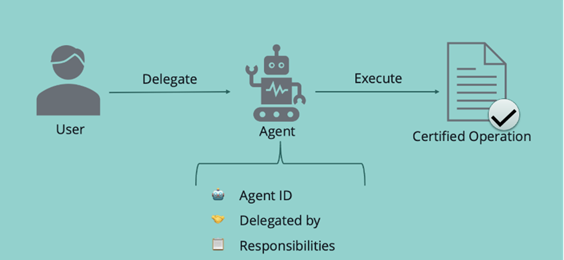
In Signaturit’s vision, an AI agent is not an independent actor. It is a delegated entity, anchored to a verified digital identity and empowered through explicit authorization. This model mirrors the physical world and is based on three core principles:
1. Identification – The human or legal entity is identified through a Digital Identity Wallet.
2. Delegation – The user explicitly delegates authority to the agent, creating a digital equivalent of a Power of Attorney.
3. Scope – The agent’s authority is strictly bounded: what it can do, in which contexts, and under which conditions.
An agent may be allowed to submit documents, or interact with services, but not to sign contracts or authorize payments unless explicitly permitted.
Crucially, autonomy does not mean loss of control. Through the Identity Wallet, users can receive notifications, review agent activity, and require human validation for actions that exceed delegated authority. This creates a model of controlled autonomy, combining efficiency with accountability.
Agentic AI, Trust Services, and the MCP Vision
As highlighted by our internal experimentation and by the broader market evolution, agentic systems will increasingly interact with trust services through APIs and interoperable protocols such as MCP. In this model, trust services become the certified backbone of agentic workflows.
This perspective aligns with the reflections in paragraph 7.7 of the “Scaling Trust” paper, which highlights how Generative AI and autonomous agents will massively increase the volume and speed of digital transactions. Contracts, authentications, attestations, and compliance checks will be executed at machine speed, often without direct human initiation.
“Wallets become the Digital Front Door By 2026, digital identity wallets will become the primary interface for citizens, businesses, and AI agents, replacing fragmented onboarding, signing, and authentication journeys across Europe and beyond.”
Scaling Trust et transactions numériques | Livre blanc
In such a scenario, the real value is not automation alone, but certification: the ability to guarantee the authenticity of both the agent and the transaction itself. Qualified trust services—identity proofing, signatures, seals, timestamps, and audit trails—become essential to ensure legal validity, evidentiary strength, and regulatory compliance, even when actions are performed autonomously by software.
At the same time, agentic AI amplifies risks. Deepfakes, impersonation, and automated fraud become easier to scale. This is why strong identity proofing, auditability, and compliance with standards such as ETSI TS 119 461 are non-negotiable. Automation must not weaken assurance; it must be anchored in certified trust.
The Role of the Business Wallet
The upcoming European Business Wallet represents a decisive step forward in this trust architecture. It will not only consolidate legal entity credentials, mandates, authorizations, and compliance attributes into a single interoperable framework, but will also open new challenges and opportunities for how companies govern digital complexity.
For businesses—especially SMEs operating across borders—the Business Wallet is set to become a tool to master administrative fragmentation: reducing duplication, streamlining compliance, and providing a single, authoritative source for identity, representation, and certified attributes.
In the context of the agentic economy, its role may go even further. The Business Wallet can potentially evolve into the place where companies:
• define and manage delegations to AI agents,
• set and enforce limits of authority (what an agent can do, where, and under which conditions),
• audit and revoke mandates dynamically as business or regulatory contexts change.
In this sense, the Business Wallet is not just an enabler of digital transactions, but a potential governance layer for agentic systems—allowing organizations to combine automation with control, and autonomy with accountability.
This foundation is what will allow agent-to-agent interactions to scale safely across borders, industries, and regulatory environments.
The transition toward an agentic economy is not just a technological shift—it is a structural transformation in how businesses operate, comply, and create value. As autonomous agents begin to initiate and execute transactions, the ability to govern complexity becomes as important as the ability to automate it.
In this context, the European Business Wallet emerges as a cornerstone of the future digital economy. Beyond simplifying identity and compliance, it has the potential to become the place where companies define mandates, manage representation, and control delegations—both to humans and, increasingly, to AI agents. It offers a way to anchor autonomy in verifiable identity, to set clear limits of authority, and to ensure that every action performed at machine speed remains attributable, auditable, and legally sound.
Looking ahead, the Business Wallet may evolve into a true governance layer for the agentic economy: a trusted control plane where organizations can balance automation with oversight, efficiency with responsibility, and innovation with compliance.
At Signaturit, we are working at the forefront of this evolution. By combining qualified trust services, Digital Identity Wallets, the emerging Business Wallet, and agent-ready architectures, we are actively shaping the infrastructure needed to make the agentic economy trustworthy by design.
Follow the upcoming innovations in trusted products and services from the Signaturit Group, a Namirial Company to stay aligned with this vision and at the leading edge of the agentic economy.